
Boiler Repair Newport: Is Your Current Boiler Still Suitable for the Way You Use Your Home?
Find out whether your existing boiler still suits your Newport home or if changing heating needs make replacement worth considering.

Why you can trust our content
We understand that the boiler industry can be confusing, with plenty of outdated or misleading information. That’s why we rely only on trusted, proven sources to guide our advice and installations:
At a glance
A boiler can continue working for years after its first signs of wear, but that does not necessarily mean the existing system remains the right fit for your household. Changes to the property, family size, hot water usage and heating habits can all affect whether repairing the current boiler makes practical sense.
For homeowners considering boiler repair newport, the immediate problem is often straightforward: the heating has stopped working, the pressure keeps dropping, or the hot water is unreliable. The bigger question is whether fixing the fault will leave you with a heating system that still meets your needs.
A repair may be the sensible route in many situations. In others, repeated faults or changing household requirements may justify considering replacement.
When is boiler repair usually the sensible option?
Repairing a boiler can make sense when the appliance is otherwise in reasonable condition, and the fault is isolated.
For example, a relatively straightforward component failure does not necessarily mean the entire boiler needs replacing. If the appliance has been properly maintained and continues to meet the household’s heating and hot water requirements, repairing it may restore reliable operation without the disruption of a full replacement.
Factors worth considering include:
- The age and general condition of the boiler
- The type and seriousness of the fault
- Previous repair history
- Availability of replacement components
- Current heating performance
- Hot water performance
- Whether the boiler remains appropriate for the property
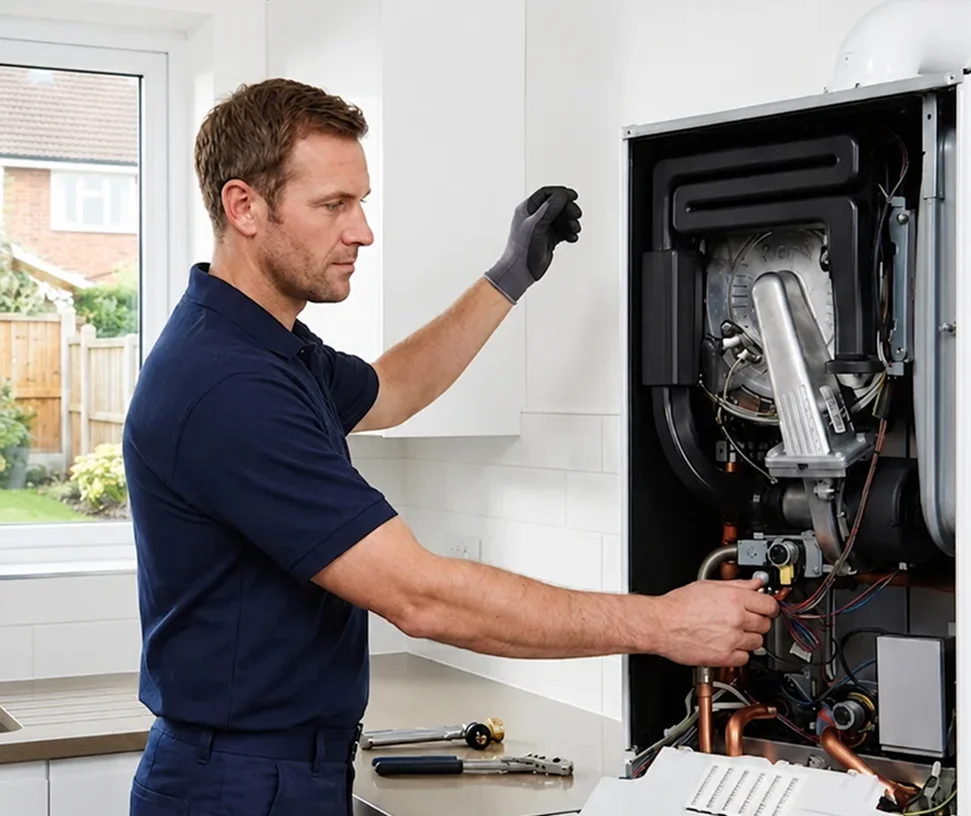
A qualified engineer can assess the fault and explain whether repair is practical.
If your boiler has developed a fault, contact Valley Gas for professional advice and an assessment of the existing system.
Could a repair hide a bigger problem?
Sometimes a single fault is just that: a single fault. However, recurring problems can indicate that the boiler or wider heating system needs more attention.
Repeated pressure loss, frequent breakdowns, unusual noises or inconsistent heating should not simply be treated as separate incidents without considering the underlying cause.
Keep a record of significant problems, including:
- How often the boiler stops working
- Which fault symptoms appear
- How frequently repairs have been needed
- Whether heating or hot water performance has deteriorated
- Whether different components have started failing
This information can help an engineer understand the history of the system.
If the same appliance requires several interventions within a relatively short period, it may be worth discussing whether continued repairs remain practical.
Has the way you use your home changed?
A boiler that was suitable several years ago may not necessarily match your current requirements.
Perhaps the household has grown, a new bathroom has been installed, or someone now works from home and needs heating throughout the day. A property extension may also have increased the heating demand.
These changes do not automatically mean a replacement is required. They do mean the system should be considered in the context of how the property is used now.
For example, a boiler originally installed for a couple using one bathroom may face considerably more demand after a family moves in and begins using several hot water outlets.
Does the boiler still provide enough hot water?
Heating and hot water requirements can change independently.
A boiler may continue to heat the radiators adequately while struggling to meet increased hot water demand. This can happen when household routines change, or additional bathrooms and showers are introduced.
Consider whether you are experiencing:
- Longer waits for hot water
- Reduced hot water performance
- Difficulty using multiple outlets
- Inconsistent water temperatures
- More frequent reliance on stored hot water arrangements
If these issues are caused by the overall system design rather than a simple boiler fault, repairing the existing appliance may not solve the underlying problem.
Could your existing boiler be too powerful or too small?
Boiler sizing is another reason to reassess an existing heating system.
A property may have changed since the original installation. Extensions, improved insulation, altered room layouts or changes to occupancy can affect heating requirements.
A boiler that is too small may struggle to meet demand, while an unnecessarily large boiler may not be the most appropriate solution for the property’s current heat load.
This does not mean an engineer should automatically recommend replacement. The first step is understanding the actual heating requirement and determining whether the existing appliance can continue to meet it.
How does boiler age affect the repair-or-replace decision?
Age alone does not determine whether a boiler should be repaired.
An older boiler that has been reliable and can be repaired economically may continue to provide useful service. Conversely, a relatively newer boiler with a serious or recurring fault may require more careful consideration.
Age becomes more relevant when combined with other factors such as:
| Consideration | What it may indicate |
| Occasional minor fault | Repair may remain practical |
| Repeated breakdowns | Further investigation may be worthwhile |
| Increasing repair frequency | Replacement may need consideration |
| Poor hot water performance | System suitability should be reviewed |
| Difficulty obtaining parts | Future repairs may become more complicated |
| Changing household needs | Existing boiler may no longer be the right fit |
The important point is to look at the overall picture rather than using a particular age as an automatic cut-off.
Which fuel powers your boiler?

Mains Gas
LPG

Other
It just takes 60 Sec
And then you can book a free consultation
What if your boiler keeps losing pressure?
A boiler that repeatedly loses pressure needs investigation rather than continual topping up without identifying the cause.
Pressure can fall for several reasons, including issues within the heating system. The appropriate response depends on what an engineer finds during inspection.
If pressure problems are becoming a regular occurrence, ask whether the underlying fault has been identified and whether other parts of the system should be checked.
Repeatedly resetting or repressurising a boiler may temporarily restore operation but does not necessarily address the reason the problem keeps returning.
Is a repair worthwhile if the boiler is still heating the home?
Possibly. A boiler does not need to be new to be suitable.
If the appliance provides reliable heating and hot water, has a manageable fault and remains appropriate for the household, a repair may be a reasonable option.
The decision becomes less straightforward when the boiler is experiencing multiple problems while also failing to meet the property’s current requirements.
This is where homeowners can benefit from asking an engineer to assess the system rather than focusing solely on the immediate fault.
Valley Gas can help you understand whether the current fault is something that can reasonably be repaired or whether the wider heating system needs consideration.
What should you ask an engineer during a boiler repair?
A repair visit is an opportunity to understand more about the condition of the heating system.
Useful questions include:
- What has caused the fault?
- Is the problem isolated or linked to another issue?
- Is the boiler otherwise operating correctly?
- Have there been signs of other components beginning to fail?
- Is the appliance still suitable for the property?
- Would the repair restore normal performance?
- Are replacement components readily available?
- Are there any safety concerns that need addressing?
- Is there anything likely to require attention in the near future?
You do not need to decide on replacement simply because an engineer identifies a potential future issue. The purpose of these questions is to give you enough information to make an informed decision.
A typical Newport home scenario
Consider a three-bedroom home where the boiler has developed a fault after several years of generally reliable operation. The household still uses the property in much the same way as when the boiler was installed, and the system has otherwise performed well.
An engineer identifies a repairable component fault. In this situation, repairing the appliance could restore the heating system without requiring a complete replacement.
Now imagine the same property has since gained an additional bathroom, more occupants and significantly higher hot water demand. The boiler is also experiencing repeated breakdowns.
The immediate fault may still be repairable, but the wider question is different. Repairing one component may not address the fact that the overall heating arrangement is no longer well matched to the household.
When should you consider replacing rather than repairing?
There is no universal rule, but replacement may become worth discussing when several factors point in the same direction.
These can include:
- Frequent breakdowns
- Increasing repair bills
- Poor or inconsistent heating performance
- Inadequate hot water supply
- Difficulty sourcing suitable components
- Significant changes to the property
- Increased household demand
- A system that no longer suits the way the home is used
A replacement should still be based on a proper assessment. The goal is not to replace an appliance simply because it has developed a fault.
Can boiler cover change the way you approach repairs?
Boiler cover can provide a different approach to managing unexpected repair costs, depending on the terms of the policy.
Cover varies considerably, so check what is actually included before relying on it. Some policies may have exclusions, claim limits, waiting periods or restrictions relating to boiler age and previous faults.
If you already have cover, check the policy before arranging independent repair work because the provider may have specific requirements about how a claim is handled.
How can you decide whether your boiler is still right for your home?
Start by separating two questions:
Can the boiler be repaired?
and
Will the repaired boiler still meet the household’s needs?
The first question is about the fault and the condition of the appliance. The second is about the wider heating system.
A boiler can be technically repairable but still unsuitable for a household that has significantly increased its heating or hot water requirements.
Equally, an older boiler can sometimes remain perfectly functional and appropriate when the property and household have not changed substantially.
Boiler Repair in Newport: Should You Repair or Replace Your Boiler?
A boiler fault does not automatically mean that replacement is necessary. In many cases, a suitable repair can restore an otherwise reliable system and extend its useful service.
The more important question is whether the boiler still suits the property and household. Changes in occupancy, bathrooms, heating demand and hot water usage can make an ageing system less suitable even when the immediate fault is repairable.
If you are considering boiler repair in Newport, Valley Gas can assess the problem and provide practical guidance based on the condition of the existing system and the way your home is used.
For professional advice on an existing boiler, contact Valley Gas to discuss the repair, replacement and heating options available for your home.
Related articles
Which fuel powers your boiler?
Mains Gas
LPG
Other
Which fuel powers your boiler?
Mains Gas
LPG
Other


